

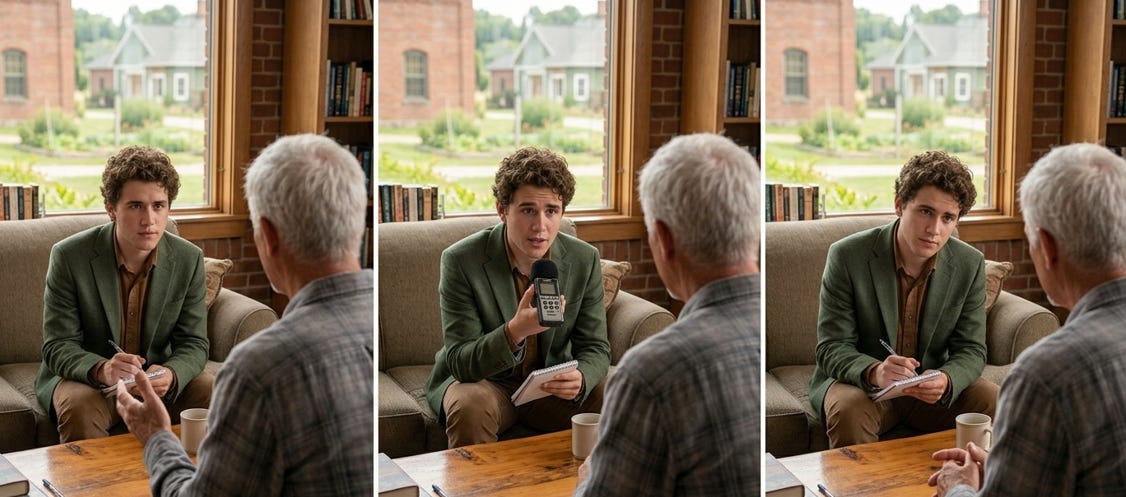
Interviewer: Jack Kingsley, Journalism Student
Interviewee: Axel, Founder of Yeti Bio Cert
Founder: Jack, it’s good to meet you, have a seat. I’m Axel, I’m the Founder of Yeti Bio Cert. I understand you are the journalism student doing this as part of your class project, reaching out to local startups in the area, is that right?
Me: Yeah, exactly! Thanks for taking the time, Axel. Honestly, when our professor posted the local startup list, your project immediately jumped out at me. It’s cool to be out here.
Founder: I understand this is just an introductory interview, maybe 10 to 15 minutes long, just an introduction to what our company is about, the problems, the solutions, etc., did I understand that correctly?
Me: Yeah, just a high-level look to get the narrative down. We can just dive right in if you’re ready? I’d love to start with the actual problem you’re tackling. Like, what’s the big friction point here?
Founder: Sounds good. Ok. I’d say that the Problem started when legislation was passed mandating that all segments of the food chain must become compliant with traceability standards set out by FSMA 204, which is the Food Safety Modernization Act, section 204. It was originally set to take effect starting January, 2026, this year, and because the compliance aspect - the requirements of what that involved - was so immense, companies pushed back on being able to meet those requirements, and so Congress was forced to move that timeline of reporting back to July of 2028, a little more than 2 years down the road. That reporting included traceability from Farm to Fork. In other words, food that is found on the shelf in a store, should be able to be traced back to the original farmer of the crop that was used to produce that product, in case of an outbreak or any questions as to the health or safety tied to the crop ever came up. Does that make sense, so far?
Me: Well, if I understand what you’re saying, we are tracing something a farmer grows, up until the point it’s sold on the shelf and eaten by people. Which makes sense, but, I have to ask, aren’t we already doing this? It just seems like this is kind of obvious, like we’d already be doing this for various reasons, like safety.
Founder: Jack, that’s exactly how I felt, too. You’d think this would already be the standard, but it’s not. You have to remember that agriculture has come a long way since it first started in this country, but even so, it hasn’t kept up with technology. So this legislation, I believe, is an effort to shore up that gap, by requiring that the segments in the food chain reflect our ability to bring it into the digital age. In fact, a lot of the language you see in this legislation, addresses that ability of being able to handle auditing requests within 24 hours, something that would never have been possible before, and that the output of those requests be formatted in digital files and spreadsheets, I imagine, for the benefit of putting all this information into a system that quickly sorts and compiles the data so it’s more easily analyzed by the USDA, the FDA, and in emergency situations like possible outbreaks, by the FDA’s CORE outbreak response team. As you can imagine, anything that speeds up the process of isolating the source of contamination or a pathogen, means mitigating the harm of that outbreak. Fewer people will be exposed, fewer people are sickened, resulting in fewer deaths. And fewer crops have to be destroyed, saving money across the industry, especially by insurance companies.
And right now, before FSMA 204, all of this information was kept in the form of paper documents, or on individual computer systems, disconnected and disjointed, taking weeks, and in the case of some outbreaks, even months, to trace. In the meanwhile, thousands and millions of bushels of crops are destroyed out of an earnest desire to get ahead of a catastrophe, trying to save lives and money.
And I can appreciate that we are finally setting this as a goal. It’s appropriate. It’s well within our level of technology. And by making it a federal mandate, it incentivizes the industry to figure out how to achieve this level of reporting, or pay heavy fines, or even be ordered to shut down operations if they fail to comply, so there’s a lot of incentive for companies to meet these new expectations. And just to be clear, it’s not that some of this isn’t already being done to a point in different parts of the world, by different companies, but it’s still fragmented, there’s no universal system that puts all of this data together, so that it can be looked at and analyzed in one big picture.
And so that is what we are hoping to accomplish with Yeti Bio Cert. We are developing a system by which the entire food chain, starting with the farmer, and ending with the last mile, the consumer, is addressed and traceable.
And the kicker, we have created a system that is entirely free for the farmer, and still spreads out the costs of integration across all segments of the food industry, but we’ll get into the details of how we do that with each segment, in the following interviews, or this will extend well past your 15-minute time frame. Plus, I completely understand that what we are proposing is a lot to take in, so smaller chunks helps people assimilate the concept more easily of what we’re talking about.
Me: Well, I can understand that. I’m already seeing that this must be a huge process to document. I mean, I feel like I have to think about how I even want to approach detailing this. How were you thinking about laying this out so it’s structured in a more digestible format?
Founder: No worries. That’s a reasonable response, and a common one, so I’ve learned the easiest way is to start at the beginning. The Farmer. And as with all systems, any engineer will tell you that the base of any structure is the most important part, because all the remaining segments will rely on the base to hold up every following segment. Does that make sense?
Me: Yes, I think so. I can follow that structure. Let me clarify a point, first - I believe you said it’s free to the farmer, your system? What does that mean?
Founder: Ah, yes. Good catch. That’s a fairly important point, and a good starting point, as it turns out. And to people outside of the agricultural community, this isn’t immediately obvious, since if you aren’t exposed to this kind of information, how would you know?
Right now, farmers have to deal with ‘cost of entry’ barriers, often these are high enough that micro farms, and even many small farms, aren’t able to pay for, and because of that, they can’t even join the farming community in a way that allows them to sell their products in the commercial sphere. The last thing we wanted to do with our system was to add to that cost barrier. They are already struggling as is. Every time fertilizer goes up, it comes out of the farmer’s profit. Every time pesticides, or labor, or equipment, or tariffs on equipment go up, it comes out of the farmer’s profits. Every time fuel goes up, because of events in the Middle East, for example, it comes out of the farmer’s profits. Not to mention weather events or the rising cost of irrigation at a time when the world is facing the growing crisis of water scarcity. And just so you understand, right now, out of every Farm Dollar that is earned on crops and livestock here in America, farmers get 11.8 cents on average. And that’s not profit, Jack, that’s 11.8 cents total. How American farmers are even able to stay operational at all is an incredible feat. Or that their segment of earnings represents the smallest portion compared to the rest of the food chain. How does that even happen? Farmers are the ones producing the food that 8.3 billion people rely on around the world, and yet American farmers have somehow managed to be locked into a system that gives them the smallest cut in the food chain, while shouldering some of the largest costs, including equipment, risk, and, what is the big piece? Oh yeah, huge tracts of land. And even though they typically receive breaks on the property tax costs, buying and owning hundreds and thousands of acres isn’t as cheap as you might expect.
So, with this in mind, we started with the goal that if we can create a system that costs the farmer nothing to join and use, and maybe could save the farmer money by using our system, and as it turns out, might even create a system that allows farmers to sell their crops at a premium price, making more money, this would be that strong base to build a company on. And so, we did.
Me: Really? Wow. Like, everyone knows how tough it is to be a farmer now days, so anything that helps the farmer is great! Although, I’m sure my instructor will tell me to stay a little more neutral, but yes, I understand why you might choose to work at your startup from this angle. How do you accomplish this? And is it really free, or do you mean it’s just a delayed cost, or a low entry cost?
Founder: Jack, I appreciate your honesty, and I can appreciate your skepticism. In this world, no one gives stuff away for free. There’s always a catch. And to be honest, I guess you could say that we are no different, we do have a catch, or rather, an expectation.
We have realized what we can accomplish with our system, even more than any legislation could dream about when they opened this door. We will give the farmer tools that he doesn’t have. We will give them the ability to be FSMA 204 compliant on day 1. We will give them the public recognition they have never had before. We will empower them to be the author of the narrative of their crops that they’ve tended to all season long, I mean who better to create the crop description than the farmer? They’ve fed and watered and protected this crop up until the point of harvest. Who has a more intimate understanding, or has a more vested interest, than the farmer? We have created a method that respects and protects the sensitive information that might normally be used to determine how large a farmer’s crop is, and in the past, how that information would have been weaponized against them to drive down the price of their crops. And so much more, this is really just the tip.
Our catch, our expectation, is that we are offering the farmer tools he has never had access to before, so we are asking that he actually uses them to their fullest extent. That is the price. Use the tools we’ve created. For free. For every farmer. Full stop.
Me: That’s… a pretty strong statement. So to be clear, can you just cut out this prose and make the claim that it really is free, no hidden costs?
Founder: Ok, Jack. My company, Yeti Bio Cert, will offer full FSMA 204 compliance starting on day one, to all farmers, including all the additional benefits we haven’t even discussed yet, at no cost to the farmer, ever.
Does that work for you? Because I’m unsure how to say it any more plainly.
And here’s the thing. Even though we started with this goal in mind, you’ll appreciate that not only is it the correct and ethical thing to do, but as it turns out, it’s strategically brilliant as well. To prove that, as the base from which all the food flows, if we make a system so valuable and at no cost to adoption, for the farmer, then everything downstream from the farmer has to follow suit, or lose out. If the farmer, every farmer, uses our system for free, we will make up for it by spreading those costs across the remaining food industry, often as micro transactions, invisible to the consumer. We’ll be spreading those costs across the industries that are currently receiving a larger slice of the Farm Dollar than the farmer. And those segments will pay it, and gladly, because by using our system, those industries will also enjoy being FSMA 204 compliant as well, at a very low cost.
Me: Alright, I’ll play along. Can you tell me more about these tools for the farmers? And we’re getting short on time, so let’s wrap it up here by finishing up with these tools and why it enables farmers.
Founder: Ok. I’ll start by describing what our portal enables the farmer to do. I’m sure a lot of small to middle sized farms are worried about the paperwork involved in achieving their own FSMA 204 compliance, keeping track of it, maintaining it, storing it, everything.
First off, our portal is accessible by any device that can open a browser, from their phone, to a tablet, a laptop or desktop, if they can open a browser on their Android or Apple device, and that even includes Linux platforms, they can access their portal – no expensive equipment to buy, no expensive software to lease or install, no months-long analysis and deployment costs charged by these tech companies that enjoy building complexity into their systems because it means higher overall revenue, in some cases of well known tech giants, as much as 30% or more of their revenue comes from the support calls dealing with the confusion of their complexity and support of the infrastructure, and we don’t do that. And it’s independent of their ability to access the internet for certain functionality, but obviously, it is a web-based portal, so eventually they do need access to the web. But those types of issues are increasingly becoming a thing of the past. I mean, I, myself, have a Starlink satellite dish, so even where I’m located, out here in the sprawling metropolis of the backwoods of the Pacific Northwest, I’m hitting speeds of 200+ Mbps downloads, 20-30 Mbps uploads, 20-30ms response times, it’s just embarrassing to think that when I first got involved with technology in Seattle, we were running those funny phone cradles that operated at 150 bits per second, and even less. Today, as a business, or even for personal use, the cost of satellite dishes falls between $100 to $200 a month, but I’m getting sidetracked here. You get the point; it’s an increasingly manageable cost.
The portal allows them, as required by FSMA, to define their farm plots of land, following either GPS coordinates or other accepted and recognized methods. Farmers already know their land coordinates, this isn’t new information, so once they enter their plot land definitions, it’s in the system, and unless they need to change or update them, they won’t have to deal with that again. Set it and forget it, it will automatically be available and included in any reporting that has to be done if an audit from the FDA requests the information, within seconds.
Once those plot designations are entered, that’s when the real fun starts. They can assign which plots will host which crops. They can record the seed lot number, the dates of planting. The fertilizer and pesticides used, on the day they are actually used, including the ability to take pics of the chemical labels on the bags, that will be stored in the portal. Any water test reports can be stored there as well, along with any notes the farmer is interested in keeping, such as crop rotation, or recording events such as possible neighboring crop contamination or flooding, etc. And since this records it in real time as it occurs, it resides in the portal, instant access, for 10 years, for each record, because we recognize that even though FSMA only requires 2 years of storage access for records, many lawsuits happen years later, so we guarantee that access for a full decade to all of their records. It’s instantly allowed farmers to have a file cabinet for all of their records right in their hip pocket, no more worrying about trying to find a wet, soggy, torn paper document years after it was stored in some box somewhere, they’ll have instant access filed by year and plot as it’s been entered. No worries. No cost.
And along with this information, they can record 3 pictures every year, of each crop, on each plot. The first, when the sprouts first burst from the ground, the second, when the crop is still green and immature, but nearing the height of its maturity, and the third, when the crop is ripe for harvest. That information will be available to the consumer, when they open their Yeti 411 app, the public-facing app, as they walk through a grocery store and scan the bar code on a package of noodles, for example. The traceability connected to the farmer’s TLC, Traceable Lot Code, will allow the consumer to actually see the wheat used in creating that specific package of noodles, see the wheat as it grew from a seedling, see the golden stalks of the actual wheat in the actual plot of the actual farm before it was harvested. It will connect people who have never seen wheat before, to the very farm that the wheat came from, to the public facing page showing the farmer and his family standing proudly on their land, sharing the message, “From our Farm to your Family, this is our pride! Please enjoy!” Scanning a can of soup opens the link to a farm in the Palouse, showing a field of lentils before harvest, even allowing the consumer to tap that Green Sprig button to send a like to that farmer and his family, that the consumer loves their product! This is what I mean when we say we are enabling the farmer to be recognized in a way that he’s never had before. How powerful is that image?
And another one of our proprietary tools, our SmartY-TLC. It’s a code that allows dock workers, without having to scan any codes, to instantly recognize the sensitivity of the food they are dealing with, if it needs to be refrigerated or handled in a specific way. It works with and allows older legacy systems the ability to recognize that it is our proprietary TLC code, so that it can be read correctly. It can create 50 trillion unique randomized non-sequential codes every year, for thousands of years. Codes that provide protection against hacking or forgery, of being guessed at. Internal logic for those codes will automatically determine if it’s a fake number, or genuine. Our portal will instantly be able to confirm that it’s a number that’s been assigned to a crop. Or not. And because food fraud and the threat of a counterfeit food products is currently plaguing the European Union right now, our proprietary system will set limits and stop any excess counterfeit products from entering the market, even if they scan, copy, and attach our label to the product they are trying to pass off. Tough luck, fraudsters! Get a real job!
And because our SmartY-TLC is so robust and free for farmers to create, they don’t have to worry about creating one TLC for a 50-acre crop. Instead, we encourage farmers to adopt new practices and new strategies in creating these proprietary TLCs.
Have you ever driven by a field of beautiful, yellow wheat, swaying in the afternoon current of a gentle wind, like the waves of a golden ocean? Have you ever noticed how the center of that crop, so uniform, so tall and ripe, looks like the pinnacle of creation? And then maybe notice, too, the edge of that plot, where the wheat seems less so? The farmer no longer has to bundle the center 70-80% of his crop along with that edge crop. He can create separate TLCs for each part of the field, and by separating them, the farmer can charge a premium price for the majority, while selling off the edge crop to buyers who aren’t interested in the premium nature, but are looking for a filler crop instead. And by creating several TLCs, he can limit his risk and exposure by creating smaller crop sizes, to guard against a pathogen or contamination being detected. If his crop is close to standing water, or the neighboring farm uses fertilizers or pesticides that get washed onto his own crops, he can harvest that portion separately. If wild game has animal paths through his crops, maybe they want to isolate that portion of their harvest with its own SmartY-TLC. And maybe it makes sense to create a size of a hundred bushels per TLC, instead of 1,000 or 10,000. Certainly, his insurance company might appreciate the limited risk in the form of a reduced insurance premium.
The farmer would be the author of their SmartY-TLC. They could define the crop, the crop description, the GS1 code assigned to that crop, the plot of land that the crop came from, and they could print that label right in the field, or preprint those labels at home, and attach them to the boxes as they’re being harvested. And even though FSMA says that the First Receiver is responsible for the ultimate acceptance of a label, if our system allows the First Receiver to “adopt” the SmartY-TLC from the farmer, or spend 15 minutes coding in their own description, we’re betting they’ll hit that “adopt” button every time. Even if they do create their own description, it’s a child TLC that’s still associated to the farmer’s original parent SmartY-TLC. Once the farmer creates their own SmartY-TLC assigned to that product, it can’t be undone, cementing the farmer as the author of their own crop and description. This is how Price Takers are transformed to Price Makers.
This isn’t all of it, but you understand, we have created tools for the farmer that will enable their authorship, that enable them to be recognized for their crops, that allow the consumer to reach out and share their love of that product with the farmer who grew that crop, to see their field, to see what a lentil looks like, to see the farmer and his family.
And this is why I say there is a catch. We have gone through the effort of creating this enablement for the farmer. To code this logic and functionality into the system, a system that is Farmer-centric, to empower the farmer at every turn to claim their sovereignty of their crop, their provenance to prove their crops are authentic, their identity connected to their crops.
So we say, use these tools - establish yourselves as the most important producers on the face of this planet. Become the Price Makers that you deserve to be. That is the catch.
Jack, I’m sorry I went over our time. But I thank you as well for indulging me in delivering this portion of the farmer’s scope of our system, because they deserve to understand. Let me know when you’re ready to get the next segment captured! I look forward to it.
Me: I’m gonna go home and go through the audio and my notes again. This is beyond anything I could have imagined. Yes, thank you, it’s been an amazing 15-minutes(?), more like 25+, but I don’t want to cut out any of it. Well, maybe the part about the woods and the satellite stuff… and I’m excited to hear more about what Yeti Bio Cert has in store! Thanks!