
THE HYDROLOGIC GOVERNANCE MANIFESTO
Document Version: 1.5 (May 2026) Status: Open-Source / Public Domain Publication (Prior Art Defensive Safeguard) Inquiries: H2O_Footprint@yetibiocert.com

Executive Philosophy: Beyond the Carbon Illusion
We cannot look at a carbon credit. We cannot find it in our pockets. We do not know what it tastes like. And we cannot feel its weight in our hand. It has become an abstract corporate shell game traded by algorithms on global balance sheets.
Yeti Bio Cert establishes the unvarnished alternative: The Water Footprint.
Water is a fluid, tactile reality linked directly to human survival. By implementing a strict system of food governance, we do not merely track food from farm to fork; we actively fight against the shrinking window of global water scarcity. Every piece of food sitting on a retail shelf sits at the absolute pinnacle of a massive, hidden pyramid of freshwater consumption. To waste food is to deplete our access to water; to invest in a system that mitigates food waste, is to invest directly in water security.
The Trophic Water Pyramid: Logistical Metrics
To ground the global water crisis for 95% of Americans, the framework dismantles abstract data into two universally understood physical baselines: the 1-Liter Bottle and the Standard 53-Foot Semi-Truck Trailer (enforced at the strict DOT legal cargo payload limit of ~45,000 lbs.).
Using baseline lifecycle water metrics mapped from global research data repositories (The Water Footprint Network) and consumer-impact frameworks (GRACE Communications Foundation), the true resource weight of agricultural loss is quantified through actual road transport physics:
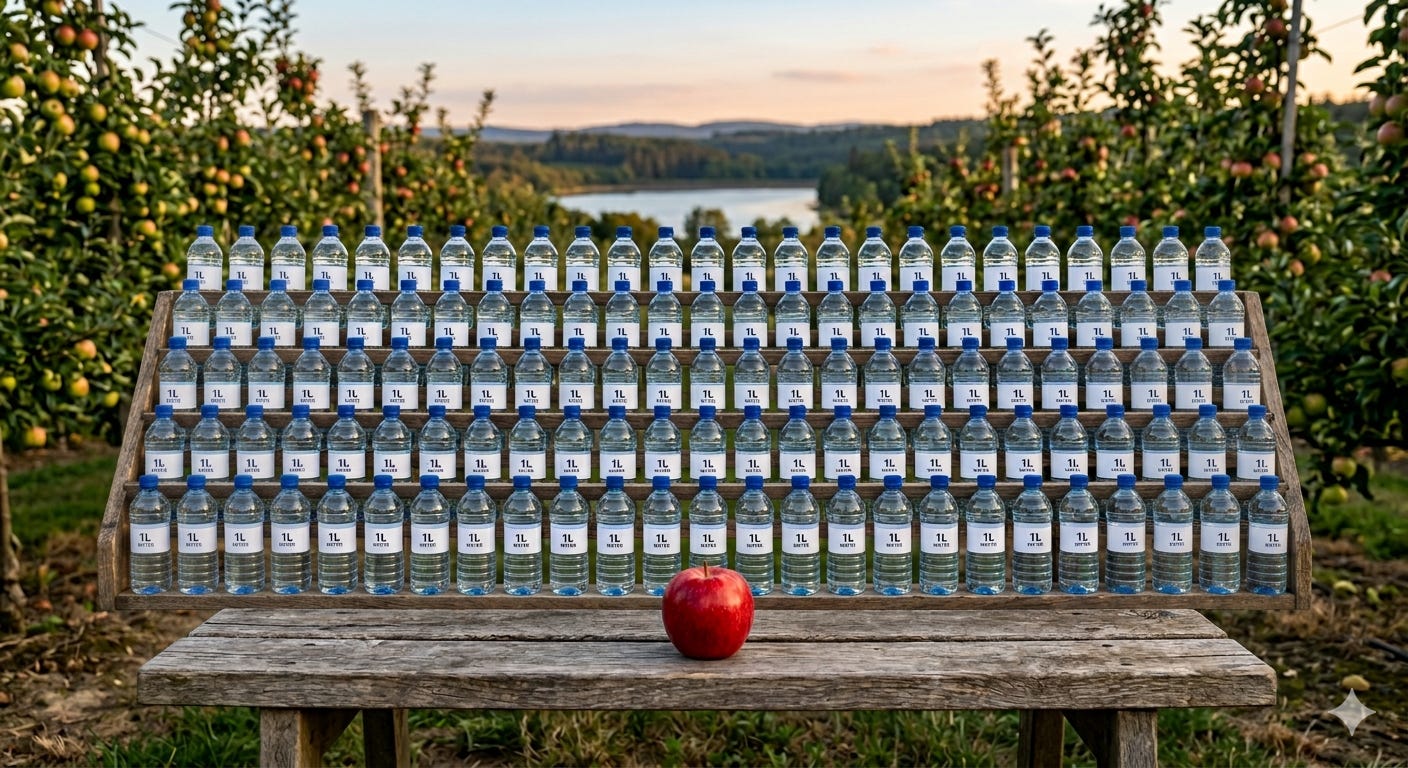
1. The Single Apple (The Atomic Baseline)
Embedded Resource: 125 Liters of Water.
The Consumer Visual: 125 individual 1-Liter bottles stacked perfectly beneath a single apple.
The Reality: Throwing away a single apple is the exact resource equivalent of dumping 125 full bottles of pristine drinking water straight down the drain.
2. The Wholesale Box (The Intermediate Case)
Embedded Resource: 15,000 Liters of Water.
The Weight Equivalent: ~33,000 lbs. of embedded water.
The Reality: A single commercial wholesale crate of produce allowed to rot on a loading dock represents a hidden resource weight that equals nearly three-quarters of a full semi-truck s entire legal highway payload, entirely dedicated to water.
3. The Commercial Pallet (The Industrial Scale)
Embedded Resource: 530,000 Liters of Water.
The Weight Equivalent: ~1,166,000 lbs. of water (Over 583 Tons).
The Real-World Transport Layout: 26 physical 53-foot semi-truck trailers running at maximum legal highway weight limits.
The Reality: Because agriculture is so resource-intensive, a single industrial pallet of food lost to a logistical, cold-chain, or paperwork error, represents a half-mile-long tactical convoy of 26 fully loaded semi-trucks driving directly to a landfill to dump pristine water into the garbage.
The Logic of the Sunk Cost: Preventing the Double-Spend
The agricultural system traps society in a dangerous double-spend cycle. Critics will claim you cannot squeeze a rotting crop to extract 132,000 gallons of water back into a declining aquifer. They are correct; that water is an irreversible sunk cost.
However, because human populations must still eat, destroying a pallet of food means market demand remains unchanged. To feed the people that food was intended for, a farmer somewhere else must pump another 26 semi-trucks worth of water out of the ground to grow a replacement pallet!
Following that compounding operational logic, one trailer load of 40 pallets of apples is equivalent to 1,037 trucks of water. At a standard tractor-trailer length of 72 feet, that represents a line of 14.1 miles of trucks parked bumper-to-bumper, a massive river of containerized water. Headed to the table, or to the dump? Choose.
YBC (Yeti Bio Cert) acts as an efficiency shield. By enforcing absolute provenance, verifying cold chains, and deploying our system to keep the original harvest inside the human consumption loop, we cancel the need for the second harvest, saving the next 26 semi-trucks of water from being drained from the planet’s aquifer.
The Operational Engine: Granular Governance & Risk Mitigation
While the foundational data of the Hydrologic Commons remains open to all, YBC deploys a proprietary, patent-pending supply chain architecture built directly at the farm gate to turn efficiency into an unassailable economic advantage.
1. The SmartY-TLC Protocol & Volumetric Lock
Traditional sequential lot codes are highly vulnerable to counterfeiting, data scraping, and global food fraud. Yeti Bio Cert establishes the SmartY-TLC: a proprietary multi-digit randomized alphanumeric Traceable Lot Code that is secure against hacking or counterfeiting, and capable of producing 50 trillion unique identifiers per year, for thousands of years. The technical term - Robust!
The Volumetric Lock: To permanently eradicate black-market counterfeiting, the system enforces a strict volumetric lock. The secure cloud portal dynamically restricts the generation of SmartY-TLC codes to the farmer’s physically verified harvest yield. A lot code cannot be duplicated; any ghost pallets entering the market with copied codes are instantly flagged and blinded by the central architecture, protecting the farmer’s true provenance, while locking the cloud portal access and potentially alerting authorities to the location of the attempted intrusion.
2. Micro-Lotting Risk Segmentation
Instead of assigning a single, sweeping lot code to an entire multi-acre harvest, the secure portal allows producers to digitally map their fields into micro-lots.
Surgical Recalls: Farmers can isolate high-risk perimeter zones (exposed to public roads or wildlife runoff) from pristine interior zones. If a pathogen incident occurs, food safety authorities can use a scalpel instead of a nuclear bomb quarantining only the specific micro-lot tied to that SmartY-TLC, saving the remaining 98% of the harvest from destruction.
Insurance Premium Underwriting: By structurally reducing total financial exposure during a recall, this micro-lotting layout enables insurance underwriters to drastically slash product contamination and recall liability premiums for participating producers.
3. Automated Expiration Intercept Routing
Through seamless integration of Key Data Elements (KDEs) required under FSMA 204 mandates, the platform actively monitors the freshness clock of pallets down to the last mile. If a pallet approaches its expiration date at a retail location, the system can automatically trigger an automated routing protocol to offload the inventory to a localized community kitchen for human consumption (90% water efficiency), pet food or livestock feed producer (70% water efficiency), or a commercial soil amendment facility (30% water efficiency), permanently avoiding the 100% total resource loss of a landfill.
The Yeti 411 App & The Blue-to-Red Consumer Lens
Working with preferred retailers and grocery chains to display resource Water Footprint metrics on proprietary retail packaging, the framework also highlights transparency directly via the consumer’s smartphone using the Yeti 411 App.
By mapping the system’s codes directly onto existing bar code labels and the industry’s transition to Q-R 2D barcodes, a standard smartphone scan can bypass corporate marketing graphics to project the unvarnished truth using a color-coded Hydrologic Efficiency Scale:
Deep Blue (Tier 1): High Efficiency (<500L/kg) Awarded to ultra-efficient, enclosed vertical farming, hydroponics, and indoor aquaponics. Indicates minimal pathogen risk, maximum water recycling and efficiency, and an isolated water loop free from outside environmental runoff.
Cyan Blue (Tier 2): Sustainable Middle (500 2,000L/kg) Managed sustainable open-field cultivation or advanced drip irrigation.
Amber/Orange (Tier 3): Cautionary Pivot (2,000 6,000L/kg) High-intensity water crops that flag a critical need for rapid logistics and smart routing to avoid waste.
Red (Tier 4): Trophic Peak (6,000 20,000L+/kg) Maximum resource-heavy products. Forces a psychological pause at checkout, signaling that losing this product to a landfill causes catastrophic environmental failure.
The Freedom of Information Mandate & Anti-Suppression Protocol
==============================================================
ANTI-SUPPRESSION MANDATE & PRIOR ART RECORD
==============================================================
We hereby declare that the mathematical frameworks, volumetric calculations, 1-Liter baseline conversion metrics, and the literal phrase and application of the Water Footprint regarding retail commerce belong permanently to the Public Domain.
Yeti Bio Cert explicitly rejects any corporate attempt to trademark, monopolize, or restrict these descriptive definitions within the global agricultural, logistical, or retail sectors. This framework is established as an open, universal standard.
Water scarcity is a global threat to human survival. Therefore, any attempt by a commercial entity or conglomerate to restrict, block, censor, or litigate against the public display of their products’ lifecycle water consumption metrics will be treated as an act of resource concealment against the public interest.
The Yeti 411 protocol operates strictly under the constitutional protections of Nominative Fair Use and the First Amendment. We do not seek corporate permission to tell consumers the truth. The data is open, the math is public, and the consumer’s right to see the hidden mile-long convoy behind the food they buy, will never be blocked. The protocol belongs to the planet.
Call to Action: Widen the Window
The visualization of food waste displayed using its individual Water Footprint metric is a non-patentable right; it isn’t and shouldn’t be owned by any individual or company, but must remain freely available for use in combating water scarcity around the globe.
Food waste, represented by the Water Footprint, will always occur, but with our system of food governance, food loss can be minimized, and so, too, water efficiency can be increased, widening that critical window for addressing water scarcity across the globe. By recognizing the Water Footprint of a food, we recognize the true efficiency and sustainability of what we produce, encouraging a new economic metric to aid the war on resource scarcity.
We invite you to join the YBC community. Commit to a system that promotes healthier food, minimizes waste, and widens the window for global water sustainability.
Reach out to: H2O_Footprint@yetibiocert.com to find out how you or your organization can participate today!