
The FSMA 204 Traceability... Goldmine?
Go ahead and read that again. And get ready to believe...

With the loss of some 15,000 family farms in 2025 alone, you would be forgiven for viewing this new FDA mandate with a cynical eye—treating it as just another corporate-sponsored government requirement meant to drive the last few nails into an already overburdened family farm’s ability to handle increased paperwork headaches and compliance costs. Surely, this will be the proverbial last straw.
Or is it?
Let’s take a look at this again, but with better eyes. Understand that when they decided to require traceability starting with the Farmer, they should have been careful what they wished for. Because they just might get it—along with everything else that is inherited with this system.
The Zero-Cost Compliance Reality
Paperwork headaches and compliance costs are assumed by the industry, but they aren’t actually required by FSMA 204. In fact, what if a company created a system of compliance that facilitated this tracking at absolutely no cost to the Farmer?
For example, what if:
The system allowed the Farmer to create the legal definitions of their plot of land just once as a “Set it and forget it” type feature? (15 mins)
The system allowed the Farmer to assign custom names to those plots, such as “The Northwest Corner Lot” or “The Prime Lentil Lot,” along with a graphical outline on a digital map? (5 mins)
The Farmer could effortlessly assign a specific crop and seed lot to that plot for the current growing season? (5 mins)
The Farmer could easily record historical data associated with that plot, such as fertilizers, pesticides, water reports, and crop rotations? (5–10 mins per entry)
The Farmer could author the actual “food description” language that will be tied permanently to that crop? (5 mins)
The Farmer could take a snapshot of the crop right before harvest, tied directly to that exact plot? (7 mins)
With our proprietary TLC (Traceable Lot Code), all of this information is easily compiled into a 10-year ledger residing in the cloud for that specific plot and season. It can be updated dynamically throughout the year as fertilizer applications, pesticide use, or water reports come in, right on the day of application or harvest.
Why take pictures of the crop? Because... (and here is where farming and traceability gets very sexy...)
Let’s talk about traceability. Real traceability. The kind of traceability being mandated by the FDA.
With our system of proprietary TLCs, starting with the Farmer’s plot and crop, every subsequent transformation event is captured with a new “Child” TLC, associated directly to the “Parent” TLC that came before it. The chain of custody spans the entire lifecycle—from the “exhaustion” (the last-mile consumption of that product), all the way back through the food processor transforming it, and right back to the very farm, the very farmer, the very plot, crop, and picture.
To make this as clear as possible, let’s look at what this truly means to both the Farmer and the Food Processor in the real world.
🗺️ Case Study: Authentic Swiss Gruyère
Farm #1 (The Huber Family)
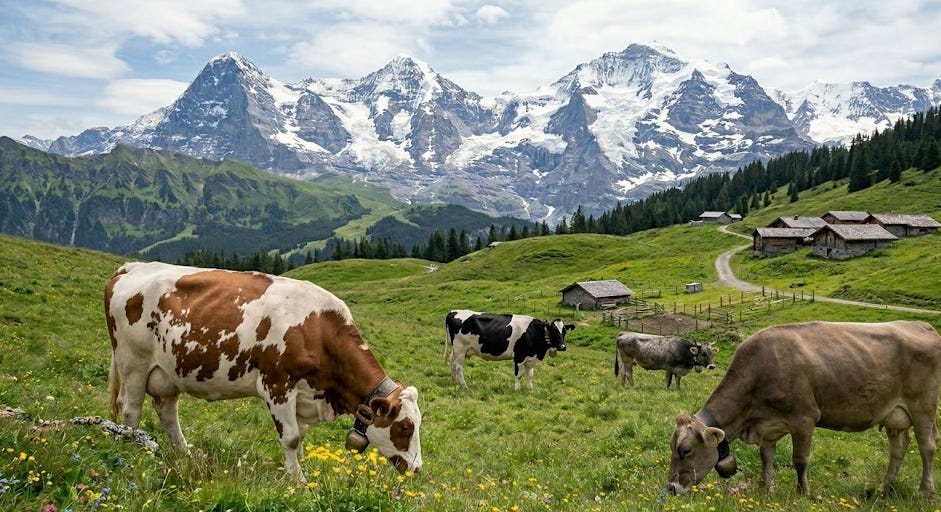
At 5:30 AM on April 12th, as the sun is casting just enough light to see by in an alpine meadow, we find the oldest son, Klaus, milking their bell-wearing Simmental cow, Heidi. He does this again at 4:00 PM, adds a note to their TLC—“Heidi contributed 25 kilos of milk today”—along with a quick picture of Heidi, before letting her loose back into the pasture. He clicks “Generate TLC” to lock in the secure, randomized parent code that saves Heidi’s contribution and photo to the system, and closes the app on his phone.
Farm #2 (The Keller Family)
At the exact same time, the oldest daughter, Seraina, is milking a classic Braunvieh cow, Greta. She logs that Greta gave 31 kilos of milk, attaches a photo, and updates her registry. After generating her TLC code, she closes her phone and meets Klaus so they can bring their fresh milk to the village center.
The Local Cheesemaker (The Artisan Processor)
The village cheesemaker collects the fresh, raw milk from Seraina and Klaus, pooling the daily harvest together into a traditional copper vat. This action generates a new, many-to-one Child TLC that permanently links back to the original parent data streams created by the teenagers. This code is tied directly to the creation of a master Gruyère wheel that will be aged in a cave for a little over a year before it is finished. Just for fun, the cheesemaker tests the camera on his new phone, capturing a snapshot of the dark, humid cave where the wheel will mature and age until perfected.
🔪 The One-to-Many Split (Defeating the Counterfeiters)
After perfect maturation is achieved, this particular Gruyère wheel has several buyers lined up, from local markets to destinations around the world. Using a wire cutter, the cheesemaker cuts the wheel into three distinct pieces, generating an individual Sub-Child TLC for each fraction, all tied back to the original master wheel:
The 3.0 kg Block (Local Tourism): Sent to a regional Swiss restaurant catering to tourists who come for fantastic, locally made Gruyère. Its Rosetta Label features a strict volumetric lock set precisely at 3.0 kg, preventing black-market counterfeiters from copying the code onto inferior cheese.
The 3.4 kg Block (International Export): Shipped directly to a specialty cheese store in Dortmund, Germany. It is protected by its own location-locked tracking token and a 3.4 kg volumetric limit, preventing duplication of its specific Rosetta Label.
The 7.1 kg Block (The Spokane Destination): Bound for a specialty boutique in Spokane, Washington. Because the Yeti Rosetta Label effortlessly wraps its alphanumeric code directly into the standard AI 10 lot code field of a traditional barcode, it slides seamlessly into the store’s existing scanner system. The label blocks the product from being accepted into any other store when scanned, completely foiling international counterfeiting rings.
🛒 Inside a Specialty Boutique in Spokane
The cheesemonger slices the imported wheel into wedges and sells them to local customers excited by the prospect of eating real, authentic Gruyère cheese from Switzerland.
A young woman pulls out her phone and scans the ordinary barcode using the Yeti 411 app. Instantly, she connects to the entire history and unbroken provenance of that authentic cheese.
She sees pictures of Heidi and Greta, the actual cows that gave the milk for her specific slice of cheese, and thinks about how beautiful those Swiss alpine pastures look. Because the farmers enabled their details, she sees Klaus and Seraina standing in the mountains. She sees a picture of the actual cave where the Gruyère wheel aged for over a year, accompanied by a message from the maker, who looks incredibly happy and proud of his work.
As she enjoys her delicious Swiss Gruyère, she wonders what kind of magic made this level of connection possible...
To which you can thank FSMA 204 Traceability mandates and Yeti Bio Cert for allowing this system to be adopted and utilized for free by the farmer, and at pennies per Child TLC creation for the processor—a cost entirely invisible to the consumer.
🚀 Who Knew Compliance Could Feel So Good?
This level of radical, unvarnished connection is currently available nowhere else in the world but through Yeti Bio Cert. By enabling the farmer and the food processor, we are introducing marketing that simply cannot be faked. These are real stories, real pictures, and real people.
Imagine consumers scanning a product and looking at the golden fields of ripe wheat stalks swaying in the setting sun of the Palouse farming region right here in the Pacific Northwest. Who knew what lentils looked like growing in the dirt? Who knew that the beautiful blossoms of canola could be such a vibrant, electric yellow, looking as if Mother Nature moved her giant paintbrush across the land?
We should embrace FSMA 204 Traceability. We should embrace it for the safety of the consumer, for the enablement of the farmer’s authorship, and for a genuine product identity tied to the processor that no corporate marketing ad can ever beat. It allows the consumer to finally see where, what, and how their food is grown, connecting them directly with the human beings who live their lives feeding the world’s 8.3 billion people.
FSMA 204 Traceability is a goldmine—if we use better eyes to see with.
Technology doing something cool for farmers 😎