

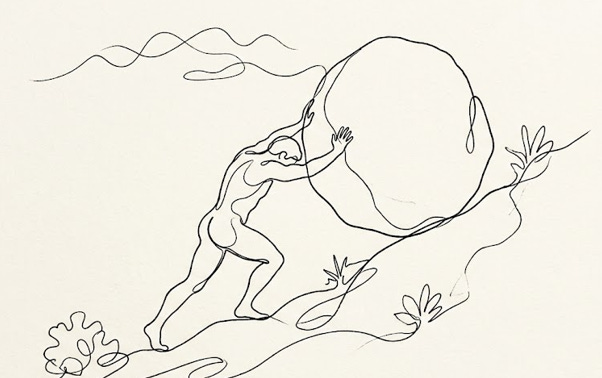
“O my soul, do not aspire to immortal life, but exhaust the limits of the possible.” - Pindar, Pythian iii (as quoted by Albert Camus)
“The struggle itself toward the heights is enough to fill a man’s heart. One must imagine Sisyphus happy.” - Albert Camus, The Myth of Sisyphus
“I dare do all that may become a man; Who dares do more is none.” - William Shakespeare, Macbeth (Act 1, Scene 7)
"Men have become the tools of their tools." - Henry David Thoreau, Walden
"The fight is never about grapes or lettuce. It is always about people." - César Chávez, from his organizing days
"Once social change begins, it cannot be reversed. You cannot uneducate the person who has learned to read. You cannot humiliate the person who feels pride. You cannot oppress the people who are not afraid anymore." - César Chávez, spoken during his human rights campaigns regarding the awakening of marginalized field workers
"It's ironic that those who till the soil, cultivate and harvest the fruits, vegetables, and other foods that fill your tables with abundance have nothing left for themselves." - César Chávez, constantly highlighted the brutal economic paradox of the agricultural industry, where the primary wealth creators are the ones starved of profit by corporate cartels
"Farm workers are not agricultural implements; they are not beasts of burden to be used and discarded." - César Chávez, from his famous 1984 address to the Commonwealth Club in San Francisco
"What is a cynic? A man who knows the price of everything and the value of nothing." - Oscar Wilde, Lady Windermere's Fan
"Most people are other people. Their thoughts are someone else's opinions, their life a mimicry, their passions a quotation." - Oscar Wilde, De Profundis
"We live in an age when unnecessary things are our only necessities." - Oscar Wilde, The Picture of Dorian Gray
"Beware, so long as you live, of judging men by their outward appearance." - Jean de La Fontaine, Fables (Book VI, "The Little Mouse, the Cat, and the Cock")
"Usually the knights would build their castles above a road, just as inns are now built beside the road, the better to plunder the people going past, though admittedly in different ways." - Jeremias Gotthelf, The Black Spider
"Ein ewiges Rätsel will ich bleiben mir und anderen." (“An eternal enigma I wish to remain, both to myself and to others.”) - der Kini, King Ludwig II of Bavaria
"To pull a good oar the five fingers must help one another." - Giovanni Verga, The House by the Medlar Tree
"Men are like the fingers of the hand—the thumb must be the thumb, and the little finger the little finger." - Giovanni Verga, The House by the Medlar Tree
“… and some are the middle finger…” - Provocateur
"The old man's got to be the old man. The fish has got to be the fish. You gotta be who you are in this world, no matter what." - Robert McCall, The Equalizer
"We are like reeds in the wind. We are the reeds and fate is the wind." - Grazia Deledda, Reeds in the Wind
"Our great anguish is life's slow death. This is why we must try to slow life down, to intensify it, thus giving it the richest possible meaning. One must try to live above one's life, as a cloud above the sea." - Grazia Deledda, from a personal letter
"The machine has arrived, it is a fact, and it has come to stay... but let us not allow the machine to swallow the man." - Miguel Delibes, from his famous 1975 speech upon entering the Royal Spanish Academy (RAE)
"The Path is a new life where you have the chance of truly finding yourself. This pilgrimage can be a return to the basics of the human nature, paying attention to the small simple things that we always forget in our busy lives..." - Miguel Delibes, El camino
"The law is a spider’s web that catches the little flies and lets the big wasps break through." - Vicente Blasco Ibáñez, from his political essays and speeches
"The earth does not belong to the man who buys it, but to the man who suffers it, who loves it, and who mixes his own sweat and blood with its dust." - Vicente Blasco Ibáñez, La barraca
“Um país se faz com homens e livros.” ("A country is made with men and books.") - Monteiro Lobato, from his lifelong educational and publishing manifesto
"Coffee passed through the Paraíba Valley like an Attila... All the sap was sucked out and, in bean form, bagged up and shipped abroad." - Monteiro Lobato, Cidades Mortas
"I know these wild rivers; I know how they flow, how they grow, what strength they have within them, where their currents run." - José María Arguedas, Los ríos profundos
"Along the arms, a name, and perhaps the first letter of the surname, soon to be completely illegible... The name has been erased from memory." - Carmen Lyra, Bananos y hombres
"Surprised by my presence, it pauses… looks me in the eye… feels like we're friends… We're both in love with sky and fields and wheat!" - Juana de Ibarbourou, Bajo la lluvia
“今の農業には、百姓が詩を書いたり歌を詠んだりする暇は、全くない” ("Modern agriculture has absolutely no time for a farmer to write poetry or compose a song.") - Masanobu Fukuoka
Pronunciation Guide (Romaji)
“Ima no nōgyō ni wa, hyakushō ga shi o kaitari uta o yondari suru hima wa, mattaku nai.”
A Quick Word on the Choice of Vocabulary
Masanobu Fukuoka used the word 百姓 (hyakushō) here instead of the standard modern word for farmer (nōka).
While hyakushō is often translated simply as "peasant" or "farmer," it carries a much deeper, historic meaning in Japan. Literally, it translates to "one hundred livelihoods" or "the person of a hundred skills." It honors the traditional rural person who had to know how to do everything—fix a roof, read the weather, weave straw, heal an animal, and cultivate the earth.